
Vietnam tests cheaper land and capped profits for middle-market housing

Illustration of a paper-model apartment tower supported by a folded ruled-paper plinth beneath a segmented translucent gauge, with a wooden gavel and model city blocks on a studio table.

Vietnam’s Ministry of Construction wants to mend a broken property ladder. It is drafting an ‘affordable commercial housing’ category to plug the gap in the country’s urban apartment market, with a target average price of 40–50 million Vietnamese dong (about $1,500–$1,900) per square metre.

The category sits between conventional social housing and the wider commercial market. The state offers cheaper land and recovery of eligible construction costs in return for a profit cap of roughly 15 per cent. The test is whether such a bureaucratic compromise can win over private developers while preserving construction quality and public value.

The core of the scheme is land allocation. Instead of making builders compete through auctions or competitive bidding, eligible plots would be allocated using provincial land price tables. This could take a hefty dose of guesswork out of the spreadsheet before the first spade hits the soil.

When auction prices soar, developers are pushed towards premium apartments because each sale must carry more of the land cost. Administered land charges give them room to target buyers without deep pockets, so they need not chase aggressive prices simply to recoup the site.

Swapping the auction block for official discretion moves the battle line. Winning a site will depend less on the highest bid than on which developer the authority picks. Provinces will therefore need clear tests of financial stamina, track record and design standards, along with explicit milestones and clawbacks for land left to gather weeds.

The gap between administered values and a possible open-market auction amounts to a public contribution, so open books and strict scrutiny are essential. They would help show that the state’s generosity reached homebuyers rather than related contractors.

A 15 per cent ceiling

A 15 per cent profit ceiling sounds tight, but it is generous next to the 10 per cent allowed for social housing. In a 2025 account, the Ministry of Construction noted that one seasoned firm had made a return of around 2 per cent after five years. It linked weak participation to low profitability and cited an industry call for a margin near 13 per cent.

In theory, 15 per cent could be enough to coax capable firms in, provided approvals are fast and eligible costs are drawn broadly. A single headline margin on development costs is fragile, though: administrative delays, interest payments and sluggish sales can erode it sharply.

The ministry’s promise to recognise actual construction expenses is reassuring. Rigid price caps invite corner-cutting on concrete and steel when raw material prices spike; a cost-recovery clause lets builders preserve structural integrity without breaching the price ceilings.

The danger of cost-plus accounting is that it can weaken the incentive to economise. Developers may shift earnings through affiliated contractors, architectural advisers or procurement arms. Keeping everyone honest will take independent cost audits and benchmark prices, along with public disclosure of related-party deals.

Regulators would do better to judge quality by outcome, with enforceable standards for structural performance, energy efficiency and after-sales warranties. This would give developers room to standardise layouts and buy materials in bulk without rewarding cheap fittings that push up maintenance costs later.

Illustration of a wide construction site with a tower crane and modern apartment buildings, showing active urban residential development.

The mortgage bottleneck

The ministry’s target is ambitious and would halve prevailing prices. CBRE, a property consultancy, put average primary prices in Hanoi at roughly 95 million dong per square metre in the second quarter; JLL recorded 98.1 million dong in Ho Chi Minh City.

Recent supply has been concentrated at the expensive end. About 16,600 new apartments came onto the Hanoi market in the first half of the year, yet for two consecutive quarters not a single newly launched project was priced below 60 million dong per square metre.

At the same time, buyers are feeling the pinch. CBRE noted that more than 5,800 Hanoi apartments sold in the second quarter, equal to 68 per cent of new supply, while secondary asking prices fell for the first time since late 2022. It linked the outlook to interest rates and buyer confidence.

Cutting sticker prices solves only part of the affordability puzzle, as a family still needs a deposit and a mortgage it can manage, and the new land and margin rules do nothing on their own to create long-term buyer finance.

Vietnam’s commercial banks rely mainly on short-term deposits, while housing needs long-term capital, which limits how many long-duration home loans they can extend. Affordable projects may therefore need stable mortgage programmes or a housing fund if discounted flats are to be manageable on monthly payments.

The draft rules would open purchases to people eligible for social-housing support, as well as to businesses, cooperatives and public agencies. To deter flipping, resales would be banned for at least five years after full payment, a safeguard against speculation but potentially an unhelpful leash on households that need to move.

Standard designs and compact floor plans

To make the maths work under price caps, builders are likely to seek repeatable designs, simpler finishes and faster construction. Standard windows, precast components and common mechanical systems could cut waste and building times while giving suppliers larger orders.

Floor plans will need similar discipline. The new category would allow more flexibility in project scale than social housing, including larger homes, but generous floor areas can wreck total affordability even when the price per square metre looks reasonable on paper.

The best developments are likely to pair compact private quarters with well-designed shared spaces near jobs, schools and transport. Cheap land on the urban fringe creates little public value if daily commuting costs swallow a household’s savings.

A regulated middle tier could ripple through the wider market. Some developers may redesign planned mid-market schemes to qualify; others may shun capped margins and stay in premium segments. Landowners, meanwhile, could see fewer auction windfalls where provinces reserve plots for the programme.

For developers, the sums add up if land costs are predictable, permits quick and infrastructure reliable. Provincial authorities have the harder task of keeping prices low while thwarting cost padding, shoddy workmanship and covert profit-shifting.

Vietnam’s blueprint is sensible in principle because it tackles land costs and developer margins together. Its success will hinge on execution more than on the headline 15 per cent. If provinces allocate good sites transparently and buyers can obtain durable financing, Vietnam may yet rebuild a working middle rung on its housing ladder.

Cebu’s flood audit turns drainage promises into a balance-sheet test

Illustration of a translucent blue engineering site plan with three drawn detention-pond outlines lifted above a stylised green hillside; two outlines align with rainwater-filled detention basins, while the third sits over an empty concrete basin-shaped cavity beside pooled water.

Cebu City is turning a flood controversy into a test of whether planning documents protect lower-lying communities from fast-growing hillside expansion. The mayor’s office has ordered 65 developers in the southern mountain barangays to submit their detention-pond blueprints and wider flood-control plans. Officials intend to inspect the sites on 27 August and compare the official drawings with the infrastructure on the ground.

A detention pond holds stormwater for a time and releases it slowly, easing pressure on the drainage network downstream. The audit follows severe flooding after heavy rain, and concern that paved slopes are sending more runoff into lower communities. Missing facilities or discrepancies will be referred to the Cebu City Legal Office rather than triggering immediate penalties.

The exercise reaches beyond a single disputed site, taking in high-end and lower-cost subdivisions alike, including Monterrazas de Cebu and Arcenas Estates. Commercially, the change is simple: paper approvals will be tested directly against physical assets.

Ponds on paper and on the ground

Development control tends to concentrate on the approval stage: engineers model runoff, consultants prepare blueprints and municipal officials sign off on drawings. Yet flood mitigation depends in the end on construction quality, usable retention capacity and maintenance long after the approvals are granted.

Cebu’s inspections could expose several distinct kinds of failure. A basin may be absent, smaller than approved or piped differently from its design drawings. Or a facility may exist but lack verifiable records of its capacity and upkeep. Each problem carries a different remedy and may leave a different party responsible.

Counting ponds will not settle the dispute. Monterrazas has claimed that it built 24 detention ponds with a combined capacity above municipal requirements. But city councillors and environmental advocates have called for independent verification, according to the local newspaper The Freeman.

A rigorous audit would match each approved basin to a specific location and an as-built record. Inspectors could then log its exact dimensions, outlet configuration and current condition, leaving an audit trail that separates design disputes from construction defects and maintenance failures.

For developers, the immediate burden centres on document management. Older projects may have records scattered across consultants, contractors and former project teams. Reassembling that paper trail can take time, particularly where the site was modified during construction.

The financial exposure goes beyond the cost of installing a missing pond. Remedial engineering on a built-out hillside can affect roads, utilities and saleable plots. It can also hold up later phases while managers check whether approvals and built assets still match.

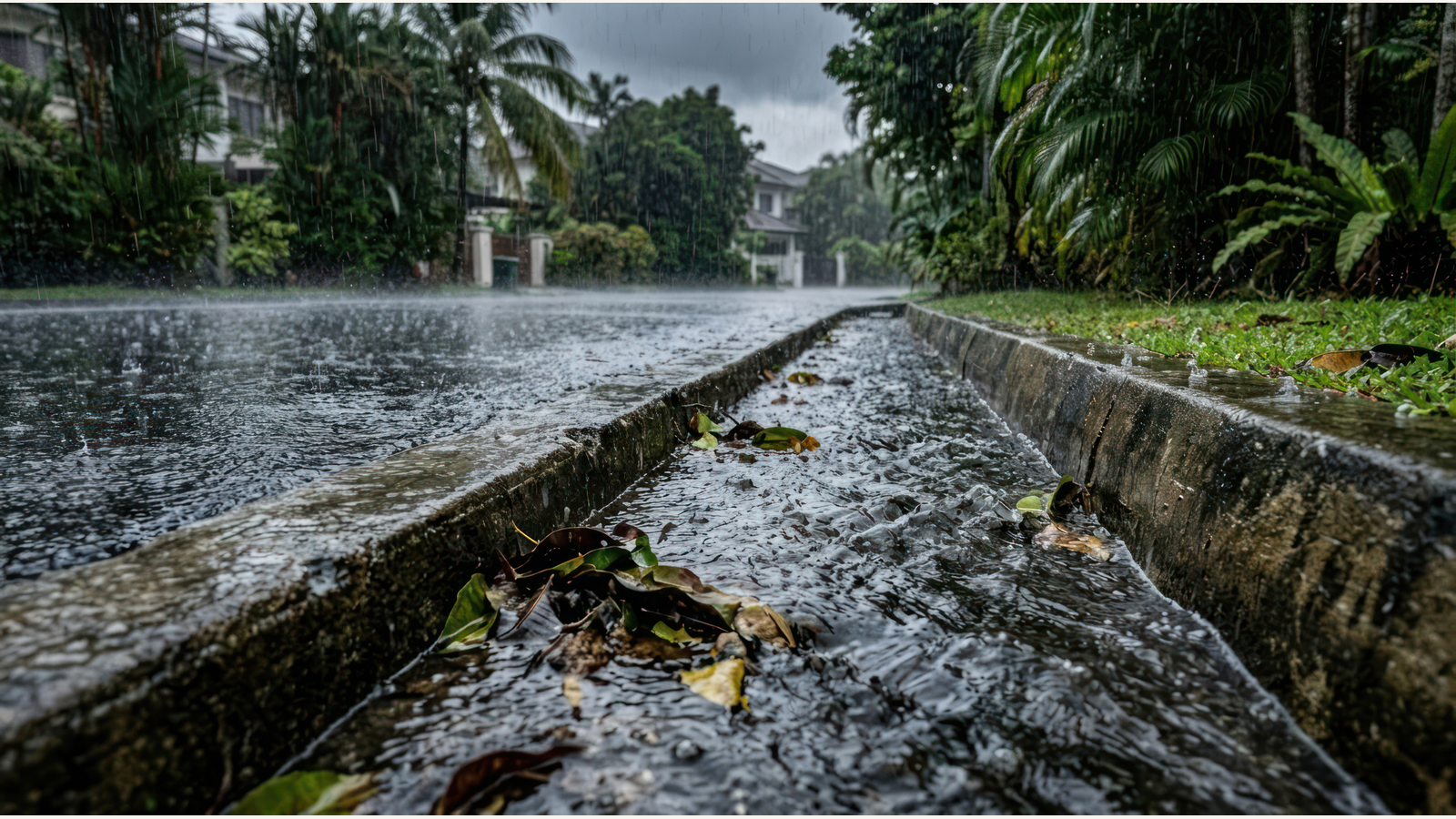
Illustration of a rain-filled engineered drainage channel with flowing water, lush green vegetation and a gray downpour.

The levers in Presidential Decree 957

The planned referral to Cebu’s legal office is significant because it makes inspection findings evidence rather than immediate sanctions. Officials must link any physical mismatch to the relevant approval, contract or legal obligation. That preserves due process, but it also means the quality of the inspection records will shape the strength of any enforcement action.

Presidential Decree 957 provides a national statutory framework for enforcing subdivision standards. It requires a performance bond guaranteeing the construction and maintenance of drainage and other core infrastructure before a licence to sell can be issued. The decree also holds developers responsible for facilities promised in sales literature or set out in approved plans.

The statute allows a licence to sell to be revoked after the required process, and a performance bond to be forfeited so the proceeds can pay for the required works. The regulator may authorise a city engineer to inspect for conformity and can have an unfinished development completed at the developer’s expense.

Those powers do not mean every finding in Cebu will follow the same path. Project age, approval terms and the status of any performance bond will all bear on the outcome. The city’s first task is to build a claim file that identifies the controlling documents and the party still carrying the legal obligation.

How that responsibility divides has real commercial weight. A developer may keep the regulatory liability while pursuing a contractor for defective work. A civil contractor may rely on completion records, while a hydrology consultant may face questions over whether the design parameters still reflect the catchment as built.

Commercial contracts will come under tighter scrutiny if Cebu demands rigorous proof of compliance. Developers may seek clearer warranties, longer record-retention duties and specific handover evidence. Contractors may price extra site testing and documentation into tenders, while consultants may narrow their technical assumptions or charge more for field verification.

Insurers and lenders will also be watching the audit. Evidence of drainage capacity and maintenance can influence how they assess flood risk, project controls and contingent remediation costs. Missing records do not in themselves prove a defect, but they make the uncertainty harder to price.

Private ponds, public drains

Private detention ponds cannot carry Cebu’s flood burden alone. The city is pursuing a one-hectare floodwater reservoir in the Tisa-Labangon area, alongside continuing waterway clearance and a review of its drainage infrastructure and its 2017 Drainage Master Plan.

These public projects and the developer audit deal with different parts of the same hydraulic network. City drainage takes water from many sites, whereas each hillside project changes runoff within its own boundaries. Oversight needs evidence at both levels, so that private compliance is not assumed to close a public capacity gap.

The city plans to report its findings publicly on 31 August. The most useful disclosure would go beyond a simple pass or fail. It would separate missing infrastructure from questions of capacity and maintenance, and make clear which files face legal review.

That degree of transparency would help compliant developers as well as the regulators. Comparable evidence can stop the wider hillside property market being treated as a single, undifferentiated flood risk. It can also show homebuyers and financiers which operators keep control of their assets after completion.

The audit’s lasting impact will depend on what Cebu asks developers to prove next. A durable regime would keep approved drawings, as-built records and maintenance logs linked throughout a project’s life. Site inspections would then check a live compliance record instead of reconstructing history after a flood.

For the real estate supply chain, the shift raises compliance costs but also clarifies responsibility. Developers who can prove capacity and upkeep should face less regulatory uncertainty. Those relying on paper approvals without the evidence to match may find that drainage is no longer a planning formality but a continuing exposure on the balance sheet.