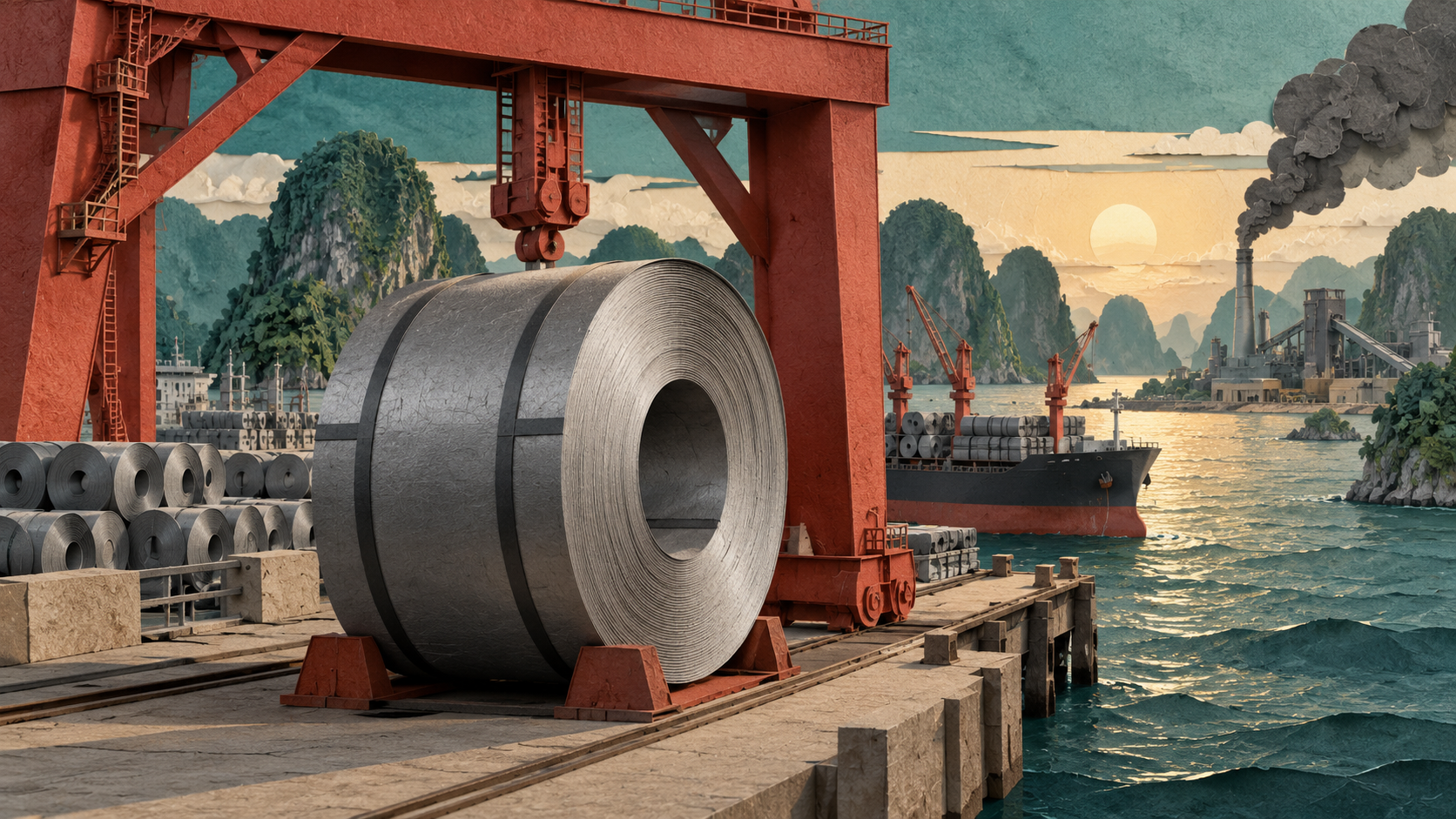
Vietnam’s steel industry has moved from recovery to rapid expansion. It produced 17.92 million tonnes of crude steel in the first seven months of 2026, up 28 per cent from a year earlier. Finished-steel output reached 21.4 million tonnes and sales rose to 21.186 million tonnes, both up by more than 15 per cent.
That is a strong industrial signal, though tonnage alone is not a simple measure of competitiveness. A durable steel industry has to sell the right grades at viable margins, and it has to withstand volatile input costs, trade barriers and demands for verified emissions data. Vietnam’s latest figures show progress on scale but leave each of those tests open.
The Organisation for Economic Co-operation and Development (OECD) puts Vietnam’s annual steelmaking capacity at 29 million tonnes. A government plan announced in February targets crude-steel production of 33–36 million tonnes by 2035, and 65–70 million tonnes by 2050.
Domestic demand is doing the heavy lifting
Construction steel and hot-rolled coil led the stronger product groups over the seven months, and they point to two different sources of demand. Construction steel goes into buildings and infrastructure, while hot-rolled coil feeds manufacturers that turn flat steel into machinery, vehicles and other products.
Volume alone can hide weakness in the product mix: coated sheet and cold-rolled steel both recorded lower production and sales. These are downstream products, where finish, consistency and customer qualification can count for as much as tonnage.
The contrast suggests that Vietnam’s near-term strength rests on basic construction demand and growing domestic supply of flat steel. It does not yet show that every processor is gaining pricing power. Producers adding capacity therefore need committed domestic buyers and a broader range of higher-value grades, rather than merely fuller furnaces.
Imports expose the limits of self-sufficiency
Vietnam imported almost 9 million tonnes of steel worth more than $6.68 billion during the seven months. It exported 6.69 million tonnes worth $4.54 billion. The resulting steel trade deficit was $2.13 billion, despite exports growing slightly faster by volume than imports.
A deficit is not in itself a sign of industrial failure. Imports may fill specifications, dimensions or delivery needs that domestic mills cannot meet economically, and they can supply processors whose finished goods create value elsewhere in the economy. Yet persistent imports alongside fast capacity growth raise a harder question about whether the new plants are closing product gaps.
Upstream, there is a further dependency. The Vietnam Steel Association says the industry still relies on imported iron ore, scrap and coking coal. More domestic crude-steel capacity can cut reliance on imported finished products, but it leaves mills exposed to freight, foreign exchange and disruption in raw-material markets.
For operators, that turns procurement from a support function into a strategic defence. Mills need a spread of suppliers, sensible inventories and contracts that share price risk. They also need flexibility in production, because a plant tied to one input route can become expensive when the cost of energy or seaborne materials moves sharply.
ASEAN offers scale but concentrates risk
The Association of Southeast Asian Nations (ASEAN) absorbed 31.33 per cent of Vietnam’s steel exports and was the largest regional destination. The European Union took 17.5 per cent. ASEAN gives Vietnamese mills a nearby market, with shorter shipping distances and familiar commercial links.
That proximity can deepen regional supply chains. Vietnamese hot-rolled coil can supply fabricators elsewhere in Southeast Asia, while specialised imports flow the other way. The result can be a more connected production base rather than a set of national markets each trying to make every grade.
Concentration also leaves exporters vulnerable to a regional slowdown or a policy response. The OECD says Southeast Asian capacity is still growing. It also found patterns consistent with trade diversion after measures against Chinese steel, including rising flows through ASEAN. That brings closer scrutiny of origin and processing, even for legitimate regional suppliers.
The wider market is unforgiving. The OECD expects global excess capacity to reach 745 million tonnes by 2028, and it recorded 75 new anti-dumping and countervailing-duty investigations in 2025. More supply chasing slow demand tends to weaken prices, and governments answer import surges with broader barriers.
Carbon data become a commercial requirement
The European Union’s Carbon Border Adjustment Mechanism, which covers iron and steel, entered its definitive regime on 1 January. European importers must declare embedded emissions and surrender certificates linked to the price in the European Union Emissions Trading System. That pushes a practical data burden back through the supply chain.
For Vietnamese mills, the immediate issue is more than paying a carbon charge. Customers need reliable plant-level emissions information to calculate their obligations. Producers that cannot provide it risk slower customs clearance, conservative default values or weaker bids against suppliers with auditable records.
Europe takes less Vietnamese steel than ASEAN does, but it can set demanding commercial standards. Investment in energy efficiency, cleaner electricity and scrap-based production can lower a mill’s exposure. Measurement systems, product-level accounting and independent verification count just as much.
Turning tonnage into resilience
Vietnam’s surge is building real industrial capability. Strong demand for construction steel and hot-rolled coil can support larger, more integrated mills. Regional exports can widen their customer base, and domestic capacity can replace selected imports.
The test is whether that scale strengthens the whole system. Success would mean fewer critical product gaps, stronger downstream sales and less fragile sourcing, along with traceable emissions and export growth that survives trade scrutiny.
If capacity rises faster than these capabilities, Vietnam could swap one dependence for another, importing more raw materials, carrying more fixed costs and competing harder in protected markets. The strongest strategy is therefore selective expansion: add capacity where domestic or regional customers need it, and treat product quality, resilient procurement and carbon records as core assets.